
Your Product Has Studies. But Do They Support Your Claims?
Product claims can look well supported even when the studies behind them do not actually prove what the company is saying. Imagine a company selling a supplement for a particular health benefit. The ingredient has been researched. There are published studies. The supplier provides scientific references. Everything appears well supported.
That difference can be easy to miss internally. It can become much harder to ignore when a regulator, retailer, investor, competitor or attorney starts asking questions.
← Back to InsightsHaving studies is not enough
Imagine a company selling a supplement for a particular health benefit. The ingredient has been researched. There are published studies. The supplier provides scientific references. Everything appears well supported.
So the company builds its marketing around the research.
Then someone looks more closely.
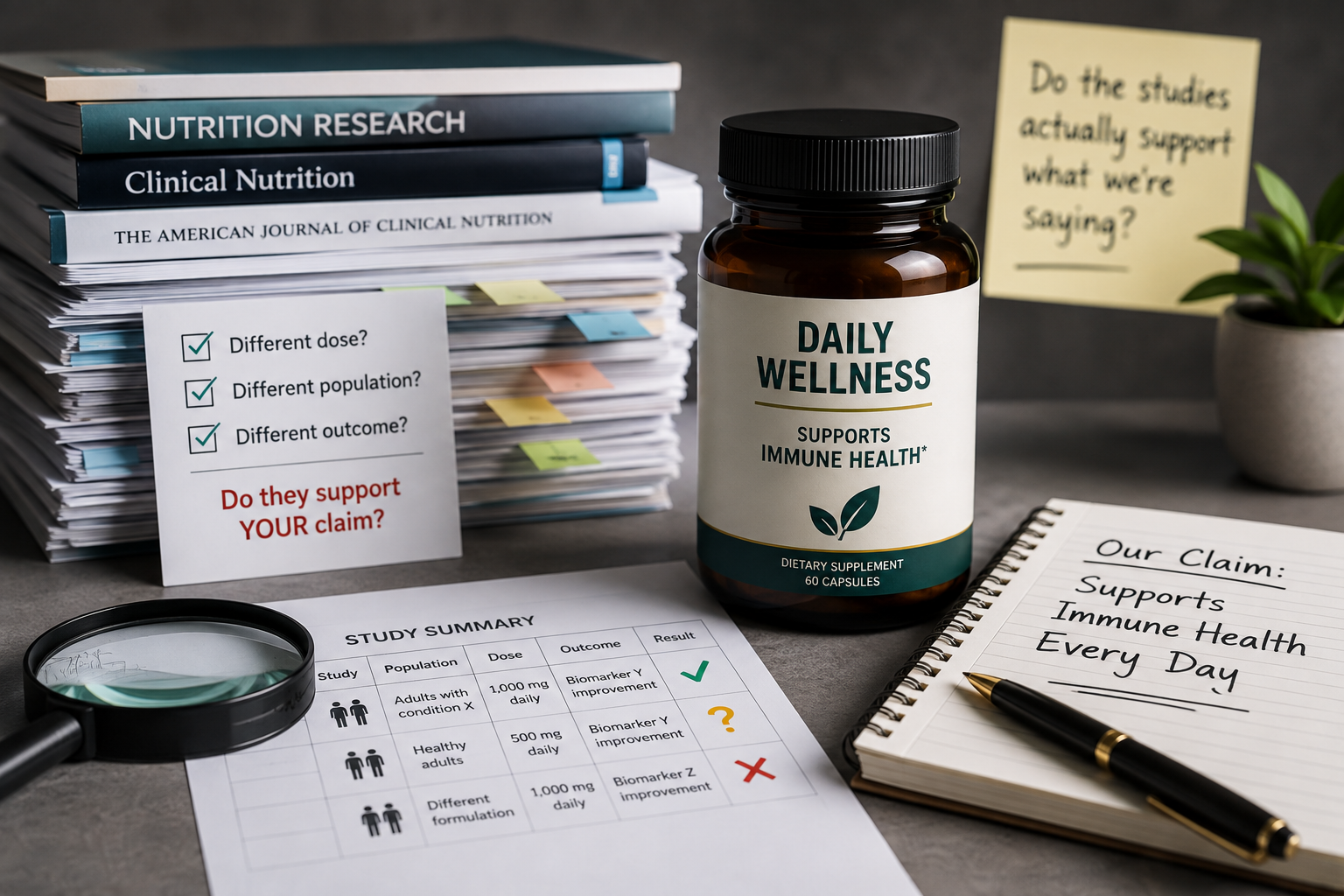
The studies used a different dose. Or a different formulation. Perhaps the participants were very different from the customers being targeted. Or the study measured one outcome while the marketing promises another.
The studies are real. The problem is that they may not prove what the company is saying about its product.
Having evidence is not the same as having evidence for the claim you are making.
Where the gap appears
Suppose research shows that an ingredient improved a particular outcome when people consumed 1,000 mg per day. Your product contains 250 mg. Can you use that study to support the same expected benefit?
Or perhaps a study found an improvement in adults with a specific condition, but your advertising suggests that healthy adults can expect the same result.
Or research supports one ingredient individually, while your marketing attributes the same result to a finished multi-ingredient formula that has never been studied.
These differences may look small during product development or marketing. They can become very important when the claim is challenged.
When Product Claims Become a Business Problem
Health-related advertising is expected to have appropriate scientific support, and the evidence needs to be relevant to the product and the claim being made.
Regulators are not the only people who may examine it. Retailers can question claims before carrying a product. Investors may examine the evidence during due diligence. Attorneys can scrutinize substantiation in litigation. Competitors can challenge advertising.
A claim that helped sell the product can therefore become a liability if the evidence behind it cannot withstand closer examination.
The question isn't whether your company has studies. It is whether those studies support the exact thing you are asking customers to believe.
That distinction can affect marketing already paid for, packaging already printed, inventory already manufactured, retailer relationships, investor confidence and the credibility of the product itself.
More studies do not necessarily solve the problem
One common response is to collect more references. But fifty studies that do not match the product or claim do not necessarily create a stronger position than a few highly relevant studies.
A laboratory study showing that an ingredient affects a biological pathway may help explain how something could work. It does not automatically demonstrate that consumers taking the finished product will experience the advertised result.
Similarly, a study of an ingredient does not automatically establish that every product containing that ingredient will perform the same way.
This is where apparently strong scientific support can become much weaker when examined closely.
Evidence strength depends on more than study count. Study design, population, intervention, dose, comparator, measured outcome, statistical and clinical relevance, consistency across studies and applicability to the finished product all affect what conclusions can reasonably be drawn. Mechanistic and observational evidence may strengthen a scientific rationale, but stronger efficacy claims generally require appropriately designed human evidence relevant to the claim being made.
The problem is cheaper to find before the claim goes public
Companies often examine substantiation after the marketing language has already been developed. That reverses the order of the decision.
If the evidence supports a narrower outcome than the marketing team wants to communicate, discovering that before packaging, advertising and launch leaves room to change the claim, strengthen the evidence or reconsider the product strategy.
Discovering the problem after scrutiny begins leaves fewer options and potentially much greater cost.
The purpose of evaluating the evidence early is therefore not simply to accumulate scientific references. It is to understand what the company can confidently say, what it cannot say, and where an evidence gap could become a business problem.
Strong claims should begin with what the evidence can actually support, not with the claim a company hopes the evidence will support.
- Federal Trade Commission. Health Products Compliance Guidance. 2022. View source
- Federal Trade Commission. Dietary Supplements: An Advertising Guide for Industry. Historical guidance superseded by the 2022 Health Products Compliance Guidance.
- Guyatt GH, et al. GRADE: an emerging consensus on rating quality of evidence and strength of recommendations. BMJ. 2008;336:924. View study
- Sackett DL, et al. Evidence based medicine: what it is and what it isn't. BMJ. 1996;312:71. View study
Are Your Claims Stronger Than the Evidence Behind Them?
Find out whether the evidence supporting your product actually supports what you plan to say about it, before the gap becomes a regulatory, legal or commercial problem.
Protect Your Product and Claims